
Rejected Papers Without Review: Why Desk Rejection Happens

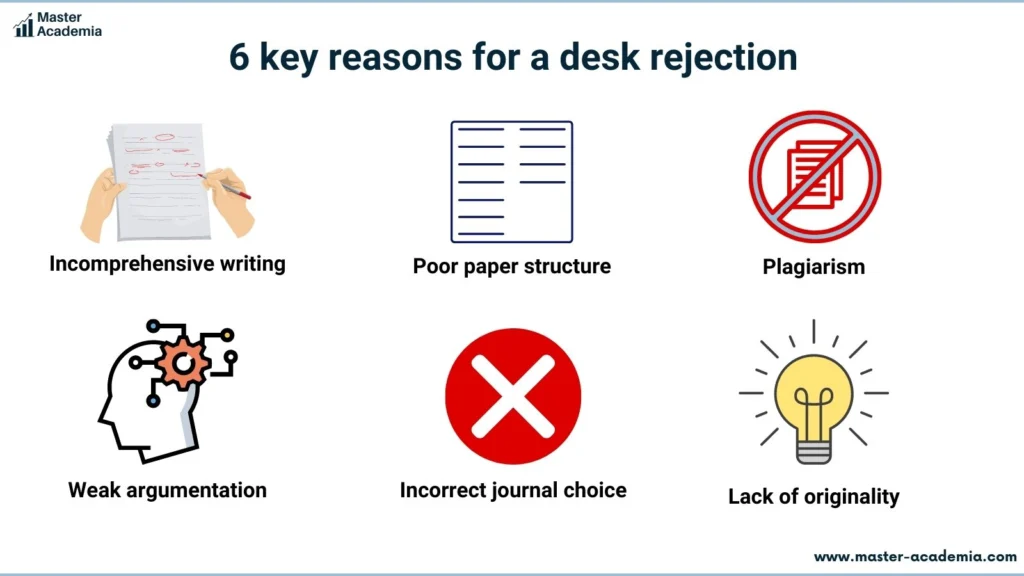
A desk rejection is an editor's decision to decline a manuscript before external peer review, usually for lack of fit with the journal's scope, an incomplete submission, or a basic quality problem. The editor screens the submission against the journal's requirements, and the decision letter usually states the general reason.
- What Does Desk Rejection Mean?
- Desk Rejection vs. Peer Review Rejection: Key Differences
- Why Do Editors Reject Papers Without Review?
- What Happens After a Desk Rejection?
- Can You Appeal a Rejection Without Peer Review?
- How to Reduce the Risk of Desk Rejection
- Frequently Asked Questions About Papers Rejected Without Review
- Sources
What Does Desk Rejection Mean?
A paper rejected without review has been declined during internal editorial screening rather than by outside experts. The desk rejection meaning is the same as internal rejection: the manuscript never reaches external peer review. Sullivan's 2015 editorial in the Journal of Graduate Medical Education defines internal rejection as an editorial decision made before peer review, and it lists the options authors face afterward.
Desk Rejection vs. Peer Review Rejection: Key Differences
A manuscript rejected without peer review follows a different path from one declined after external review. The point in the process changes who decides, what the letter says, and what an author can do next.
| Point of decision | Who decides | Typical causes | What the letter says | Next step |
| Before external peer review (desk rejection) | Editor or editorial office | Out of scope, incomplete files, weak novelty, basic formatting or reporting problems | The decision and a general reason, usually without reviewer comments | Read the reason, check fit, revise for another journal, or appeal if the editor misread the paper |
| After external peer review | Editor, using reviewer reports | Methods or evidence gaps, unclear analysis, overstatement of conclusions | A summary of reviewer critiques and the editor's decision | Revise if invited; otherwise strengthen the study and submit elsewhere |
| Rejection with invitation to resubmit | Editor | The topic may fit, but the paper requires fundamental changes | An explanation of required changes and the conditions for resubmission | Rewrite as requested and resubmit as a new version |
Knowing which stage produced the rejection matters because the next step is different. A desk rejection with no reviewer comments calls for a scope or presentation decision, while a post-review rejection usually points to study design or evidence problems. The decision letter normally signals which of these paths applies.
Journals that adjust these steps are covered in what comes after traditional peer review.
Why Do Editors Reject Papers Without Review?
Editors screen submissions with limited time, so the first decisions often rest on checkable items.
- Scope and aims: A manuscript that does not fit the journal's aims and scope is usually returned quickly. Editors compare the topic, approach, and expected audience before inviting reviewers; a study written for one field would fail this screen in another field.
- Novelty: A paper that repeats an established finding without a new question or data set may be judged as adding too little. The editor may state "insufficient novelty" with no reviewer comments attached.
- Incomplete submission: Missing files, absent conflict-of-interest statements, missing ethics approval, or failure to use the required template can stop a paper before review starts. The editorial office often writes back to request the missing items first.
- Basic quality: Weak writing, unclear figures, conclusions that go beyond the results, or obvious reporting errors can suggest the paper would not survive review. Some journals return the manuscript with a note that the reporting is not ready.
- Format and checklist: Disregarding length limits, blinding rules, or structured-reporting checklists such as CONSORT or STROBE is an avoidable cause. These guides are often checked before the paper enters peer review.
These causes vary by journal, but the shared test is whether the manuscript is ready for review and matches the journal's stated purpose. Editors make that call from the submission itself, which is why published author guidelines matter.
Desk screening can also be understood as part of desk rejection and peer review pressure.
What Happens After a Desk Rejection?
The first step is to read the decision letter carefully: most journals state the general reason, and the letter is the most specific evidence an author has. Sullivan's 2015 editorial in the Journal of Graduate Medical Education covers this stage and describes the editorial options after a rejection. A desk rejection usually provides no reviewer reports, so there is no review round to address; the author works from the stated reason rather than from reviewer suggestions.
- Check the reason against the journal's aims and scope and the original cover letter.
- Fix addressable problems such as missing files, formatting, or weak reporting.
- Decide whether to submit elsewhere, withdraw the paper, or appeal.
- Tailor the manuscript to the next journal instead of sending the same file.
A separate look at the 2015 peer review survey findings covers what authors and reviewers report about the process.
Can You Appeal a Rejection Without Peer Review?
Yes, but appeals rarely change the decision. COPE guidance on appeals advises journals to apply clear editorial criteria, and the strongest appeals show a procedural error, a factual misreading of the manuscript, or an undisclosed conflict of interest. An appeal should be brief, respond to each stated reason with evidence from the manuscript or the journal's guidelines, and ask the editor to reconsider under the journal's policy. Before appealing, compare the rejection reasons with the published aims and scope to see whether the editor may have misread the submission. Disagreement with the editor's judgment about fit or novelty is not usually a valid basis, and a better fit at another journal often resolves the issue faster. Journals are expected to handle appeals through their editorial ethics policy.
How to Reduce the Risk of Desk Rejection
Several steps reduce the chance of a desk rejection before submission:
- Match the journal before writing: read the aims and scope, recent issues, and the audience the journal serves.
- Follow the author guidelines exactly: length, abstract structure, blinding, citation style, and reporting checklists for the study design.
- Write a specific cover letter that states the research question, the contribution, and why the paper fits this journal's scope; avoid repeating the abstract.
- Check for completeness: all files, figures, permissions, and forms should be present before submission.
- Avoid redundancy: report one study per paper and explain how it builds on earlier work so the editor can see the advance quickly.
The most common avoidable mistake is choosing a journal by prestige alone without checking the fit; a mismatch can produce a desk rejection before the editor reads the full paper.
Journal websites now commonly post author guidelines online, a change that followed how publishing models evolved.
Frequently Asked Questions About Papers Rejected Without Review
- What is it called when an article is immediately rejected from a journal's editor?
It is called a desk rejection or an internal rejection: the editor declines the manuscript before external peer review.
- What are the common reasons for rejection?
Scope mismatch, lack of fit with the journal's aims and scope, insufficient novelty, incomplete formatting, and basic quality problems.
- What does it mean when a study is not peer-reviewed?
It means the paper did not go through external expert review; only editorial screening occurred.
- What are the different stages of rejection?
Desk rejection before review, rejection after peer review, and rejection with an invitation to resubmit.
- Can you appeal a desk rejection?
Yes, but appeals rarely change the decision; an appeal must respond to the editor's stated reasons with evidence.
Sources
Sullivan, G. M. "What to Do When Your Paper Is Rejected." Journal of Graduate Medical Education, vol. 7, no. 3, 2015. Full text available from PubMed Central at https://pmc.ncbi.nlm.nih.gov/articles/PMC4537151/.
COPE. Guidance on editorial rejections and appeals. Available at https://publicationethics.org/resources/guidelines.
Keep reading