
Peer Review: An Introduction and Guide for Reviewers

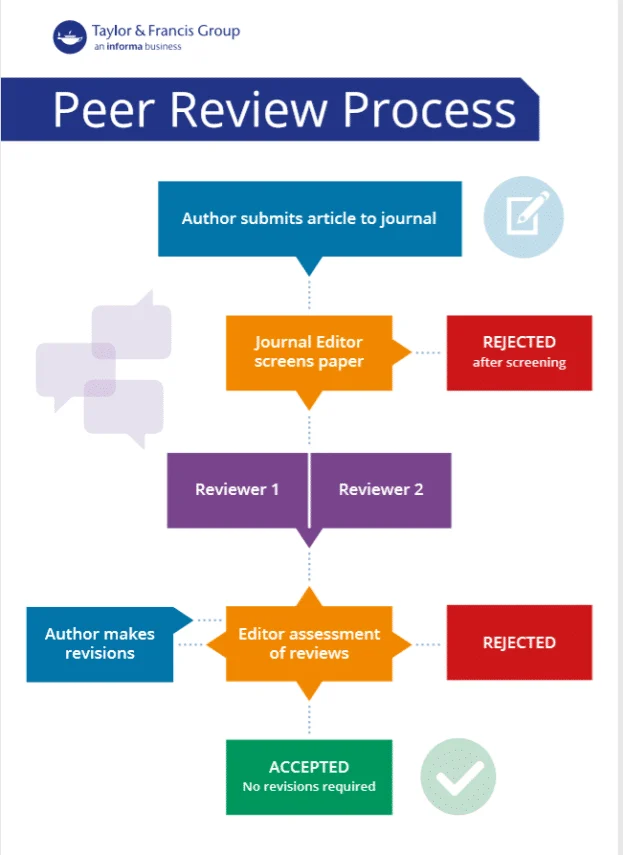
Peer review is the evaluation of a manuscript by independent experts before publication. A review report typically opens with a short summary of the paper and its main contribution, followed by major and minor comments and a confidential recommendation to the editor. This guide explains each step, with an opening-paragraph template and examples for new reviewers.
- What peer review is and why journals use it
- How the peer review process works for reviewers
- Types of peer review: single-blind, double-blind, open and post-publication
- How to write the opening paragraph of a review
- When to accept, decline, or flag a conflict of interest
- How to structure the review report
- Constructive language for comments to authors
- When you are not expert enough: co-review and disclosure
- Frequently asked questions
- Sources
What peer review is and why journals use it
Peer review is a journal's main quality filter. Before a manuscript is accepted, editors ask independent researchers in the same field to judge its methods, reasoning, and fit with the journal. The evaluation is advisory: reviewers comment, and the editor decides. The aim is to catch errors, improve clarity, and give readers some assurance that an impartial check took place. Most scholarly journals rely on peer review for original research papers, and reviewers are usually unpaid volunteers, which is why journals often struggle to find enough people to review.
The ICMJE Recommendations for the Conduct, Reporting, Editing, and Publication of Scholarly Work in Medical Journals frame peer review as impartial, confidential scrutiny by experts who are not part of the editorial decision. Journals may use different models, and the pressures on this system are examined separately in the article peer review under pressure.
How the peer review process works for reviewers
Reviewers usually follow a standard sequence. The editor selects people who know the topic, sends an invitation with the title and abstract, and sets a deadline; many journals ask for comments within two to four weeks. The 2008 survey of researchers described how authors and reviewers moved through that sequence, and the 2015 survey of researchers updated the picture a decade later. The Committee on Publication Ethics (COPE) describes the reviewer's core duties as confidentiality, objectivity, and timely disclosure of competing interests. The steps are:
- Invitation. The editor sends the manuscript, its title, the requested deadline, and sometimes the abstract. The reviewer checks whether the topic fits their expertise and whether they have time. If not, a quick decline is more useful than a late one.
- Disclosure. The reviewer declares any conflict of interest on the journal's form before reading the full paper. Journals may assign a different reviewer if the interest is disqualifying.
- Read and evaluate. The reviewer reads the whole manuscript, then checks the methods, data, reporting, and conclusions against the journal's reviewer guidelines. Notes on specific sections are more useful to the editor than a single overall impression.
- Write the report. The reviewer writes a short summary, separate major and minor comments, and a confidential note to the editor. Numbering the comments helps the authors respond point by point.
- Recommendation. The reviewer recommends accept, minor revision, major revision, or reject. The editor weighs all reviews and makes the final decision, but a clear rationale helps the editor act.
Types of peer review: single-blind, double-blind, open and post-publication
Four models are common in scholarly publishing. They differ in who sees whose identity and when the comments appear. Some journals also use triple-blind or hybrid variations, but the following table covers the main routes.
| Model | What is hidden or revealed | Load for the reviewer |
|---|---|---|
| Single-blind | Reviewers know author names; authors do not know reviewer names. | Reviewer can use author identity as context, but must guard against bias. |
| Double-blind | Neither author nor reviewer names are revealed. | Reviewer works with an anonymized manuscript and must avoid speculating about identity from self-citation. |
| Open | Names may be revealed to each other, and reviewer comments may be published with the review. | Reviewer writes for a public record; some reviewers decline because comments are signed. |
| Post-publication | The article is published first, and comments are invited afterwards. | Reviewer comments appear on the published version, often without a confidential channel to the editor. |
Open review connects to broader moves toward full open access, while experiments after the traditional four models are covered in innovations in peer review. Journals choose a model based on editorial priorities such as accountability, author anonymity, or speed, and single-blind remains common in many fields of science and medicine.
How to write the opening paragraph of a review
The opening paragraph should tell the editor what the paper claims and whether it fits the journal. A useful template is:
Template: "The manuscript, [title], reports [study type or data]. Its main contribution is [one or two findings]. The topic fits [journal name] because [reason]. Overall, the paper is [clear or complete], but [main concern]."
Two short examples show the difference between writing that only reacts and writing that informs the editor.
Before: "This is a good paper. I liked the methods. The authors did a lot of work."
After: "The manuscript reports a randomized trial of two feedback methods in undergraduate biology courses. Its main contribution is evidence that structured feedback improved revision quality more than open comments. The topic fits this journal's focus on teaching practice, but the analysis does not yet account for baseline differences between groups."
Before: "The paper is about peer review. It is interesting. I suggest some changes."
After: "The manuscript describes a survey of editors in scholarly journals and reports that most say they struggle to recruit reviewers. Its contribution is a current description of reviewer shortages. The topic suits this journal's readership, but the response rate is not reported, which limits the findings."
The opening paragraph should be factual and neutral; it is not the place for praise, criticism of authors, or a final verdict on acceptance.
When to accept, decline, or flag a conflict of interest
Accept only when you are competent and impartial. COPE guidance treats a conflict of interest as anything that could make a reviewer's judgment less independent, including recent collaboration, shared funding, personal relationships, or direct professional benefit from the manuscript. Ask five questions before accepting:
- Do I know the methods well enough to evaluate them?
- Have I worked with the authors recently, or do we share funding?
- Could I gain professionally or financially from the manuscript's acceptance or rejection?
- Can I keep the manuscript confidential?
- Can I return the review by the journal's deadline?
Answering yes to any of the first three usually means declining, or telling the editor and letting the journal decide whether the interest is manageable. Confidentiality begins the moment the invitation arrives: the manuscript must not be shared, discussed, or used in your own work.
How to structure the review report
A useful report separates the paper's contribution from the detailed comments. The European Association of Science Editors (EASE) publishes guidance on writing review reports, which moves from checking the journal's reviewer guidelines to finalizing the report. The following structure puts that guidance into practice:
- Summary. State what the paper reports and its main claim in one to three sentences.
- Major comments. Identify problems with design, analysis, or interpretation that affect the conclusions.
- Minor comments. List wording, references, figure labels, and reporting details that need limited fixes.
- Confidential comments to the editor. Include the recommendation and any concerns not meant for the authors, such as suspected misconduct that needs investigation.
- Recommendation. Choose accept, minor revision, major revision, or reject, and make sure the recommendation matches the severity of the comments.
Keeping major and minor comments separate helps authors prioritize revisions and helps the editor see at a glance whether the paper needs substantial new work or limited fixes.
Comments should point to the manuscript, not the author. Replacing personal judgments with observations about the text keeps the review fair and useful, and it gives authors a change they can act on without becoming defensive.
Before: "The authors do not understand statistics."
After: "The statistical test used in section 3 does not match the study design; a mixed-effects model would fit the repeated measures."
Before: "The writing is bad."
After: "Several transitions between sections 2 and 3 repeat the same point; condensing them would make the argument easier to follow."
The second version in each pair names the section, the problem, and the fix. That is enough for the editor and usable by the authors.
When you are not expert enough: co-review and disclosure
If part of the paper falls outside your expertise, say so before agreeing. Some journals allow co-review with a colleague or trainee, but the rules vary. EASE and COPE guidance expect the invited reviewer to disclose who helped and to remain responsible for the final report, including its accuracy and confidentiality. If no arrangement for co-review exists, decline the parts you cannot judge and tell the editor which sections those are.
Frequently asked questions
What are the four steps of peer review?
Submission and initial editorial check, reviewer assignment, review, and editorial decision; the reviewer's part is read, evaluate, write, recommend.
Why is peer review important?
It checks validity and clarity before publication, filters errors, and signals that a journal applied independent scrutiny.
How long does the peer review process take?
Publisher processes vary; reviewers often receive 2–4 weeks; add author revision and extra rounds to estimate total time.
What is the difference between major and minor revisions?
Minor revisions are limited fixes; major revisions require substantial new analysis or restructuring before the editor reconsiders.
Can I use AI to write a peer review?
Only under journal policy; most require disclosing tool use, and the reviewer remains responsible for accuracy and confidentiality.
Sources
- COPE, Ethical Guidelines for Peer Reviewers (publicationethics.org).
- ICMJE, Recommendations for the Conduct, Reporting, Editing, and Publication of Scholarly Work in Medical Journals.
- EASE, How to Write a Review Report.
Keep reading