
arXiv submissions per year, and how bioRxiv and medRxiv compare

arXiv received 284,486 new submissions in 2025, 16.6% more than in 2024 and the most of any complete year since it opened, according to its monthly submission statistics. The yearly count has risen every year since 1992, its first full year, and by late November 2026 it had already passed the 2025 total. The two main life-science servers are much smaller: bioRxiv posted 49,318 new preprints in 2025 and medRxiv 15,027.
arXiv new submissions by year, 1992–2026
The yearly figures are arXiv's monthly counts added up by calendar year. The statistics page describes them as "the number of new submissions received during each month since August 1991", and arXiv's annual reports give the same totals for 2023, 2024 and 2025.
| Year | New submissions | Change on previous year |
|---|---|---|
| 1992 | 3,263 | — |
| 1993 | 6,743 | +106.7% |
| 1994 | 10,097 | +49.7% |
| 1995 | 13,014 | +28.9% |
| 1996 | 15,866 | +21.9% |
| 1997 | 19,624 | +23.7% |
| 1998 | 24,172 | +23.2% |
| 1999 | 27,704 | +14.6% |
| 2000 | 30,601 | +10.5% |
| 2001 | 33,214 | +8.5% |
| 2002 | 36,121 | +8.8% |
| 2003 | 39,414 | +9.1% |
| 2004 | 43,727 | +10.9% |
| 2005 | 46,855 | +7.2% |
| 2006 | 50,227 | +7.2% |
| 2007 | 55,638 | +10.8% |
| 2008 | 58,915 | +5.9% |
| 2009 | 64,047 | +8.7% |
| 2010 | 70,131 | +9.5% |
| 2011 | 76,578 | +9.2% |
| 2012 | 84,603 | +10.5% |
| 2013 | 92,641 | +9.5% |
| 2014 | 97,517 | +5.3% |
| 2015 | 105,280 | +8.0% |
| 2016 | 113,380 | +7.7% |
| 2017 | 123,523 | +8.9% |
| 2018 | 140,616 | +13.8% |
| 2019 | 155,866 | +10.8% |
| 2020 | 178,329 | +14.4% |
| 2021 | 181,630 | +1.9% |
| 2022 | 185,692 | +2.2% |
| 2023 | 208,493 | +12.3% |
| 2024 | 244,031 | +17.0% |
| 2025 | 284,486 | +16.6% |
| 2026 (partial, to Nov. 28) | 347,747 | — |
Source: arXiv's monthly submission statistics, summed by calendar year; 1991 is left out because arXiv opened in August of that year. The underlying monthly figures can be downloaded from arXiv as a CSV file.
Growth has not been even. In 2021 and 2022 the count rose by about 2% a year. Each of the next three years then added more submissions than any year before it: 22,801 in 2023, 35,538 in 2024 and 40,455 in 2025.
Over the longer run, arXiv passed 10,000 submissions a year in 1994, 50,000 in 2006, 100,000 in 2015 and 200,000 in 2023. The 2026 count is still open: the 347,747 logged by November 28 were already about 22% more than in all of 2025, and September and October 2026 were the first months with more than 40,000 each.
Computer science drove most of the recent growth
arXiv's 2025 annual report says computer science papers made up 46% of that year's submissions, physics 30% and mathematics 15%. Its report on submissions by category since 2022 gives monthly counts for each category, which add up as follows.
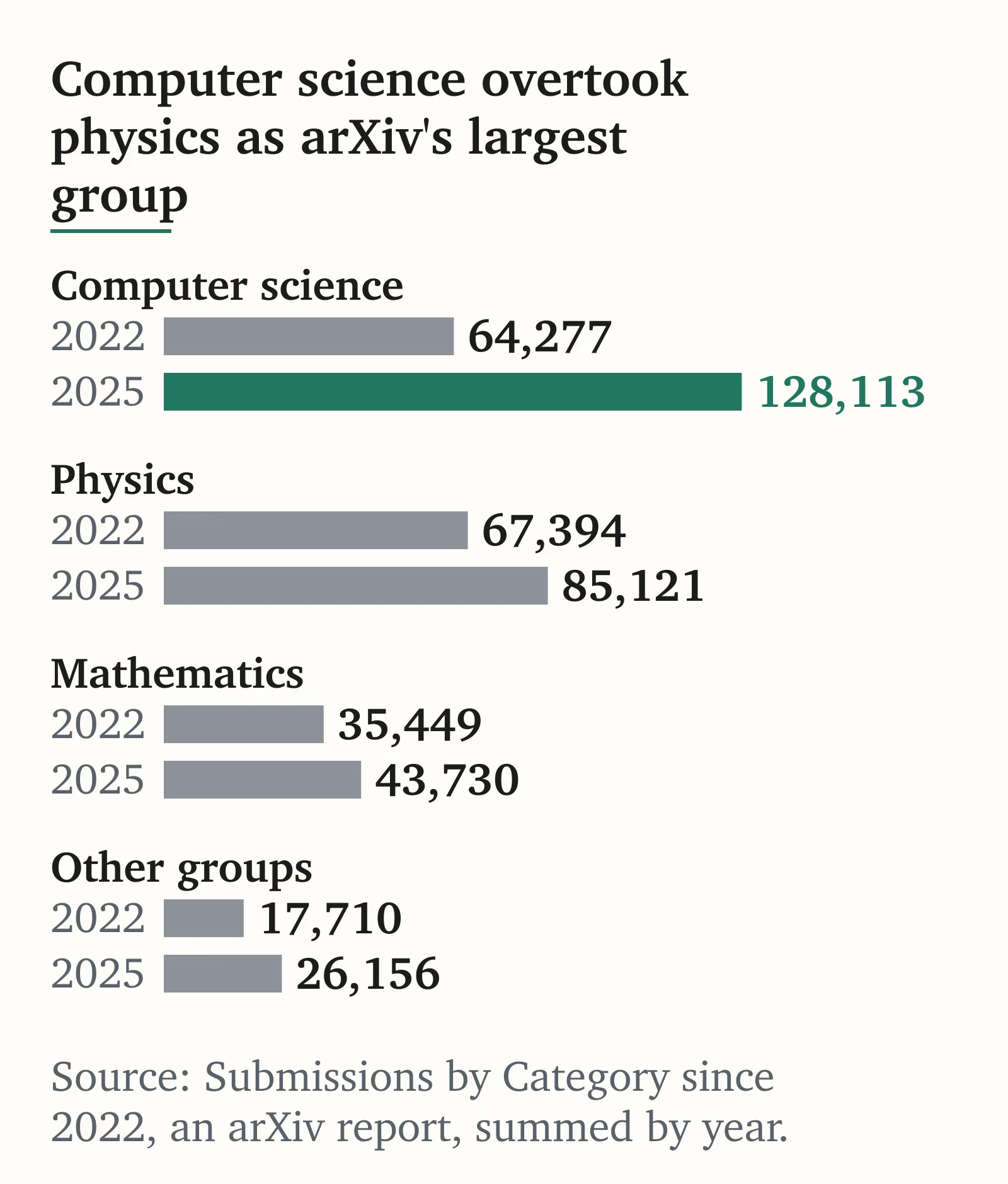
| Subject group | 2022 | 2025 |
|---|---|---|
| Computer science | 64,277 | 128,113 |
| Physics | 67,394 | 85,121 |
| Mathematics | 35,449 | 43,730 |
| Other groups | 17,710 | 26,156 |
Physics here covers 12 archives, from astro-ph to quant-ph; mathematics includes math-ph; the other groups are eess, stat, q-bio, econ and q-fin.
In 2025 computer science made up 45.3% of the category total, physics 30.1%, mathematics 15.4% and the other groups 9.2%. Computer science submissions doubled in three years and account for about 65% of the increase between 2022 and 2025. Physics grew by 26% and mathematics by 23% over the same period. Physics was still arXiv's largest group in 2022; computer science overtook it in 2023, with 80,432 submissions against 70,692.
The category totals, 184,830 for 2022 and 283,120 for 2025, run slightly below the monthly figures (284,486 for 2025), and the page does not explain how cross-listed papers are counted. This sum gives computer science 45.3% of the category total, or 45.0% of the 284,486 monthly total; the annual report says 46% and does not explain its method.
bioRxiv and medRxiv, 2016–2025
bioRxiv was founded by Cold Spring Harbor Laboratory in 2013 for the life sciences. medRxiv, founded by Cold Spring Harbor Laboratory, Yale University and BMJ, takes clinical and health research and posted its first papers in 2019. Both are now operated by openRxiv, a nonprofit.
Their yearly counts come from the servers' public API, documented at api.biorxiv.org. For each year it reports a "new_papers" figure and, separately, "revised_papers"; the table uses the first (bioRxiv data, medRxiv data).
| Year | bioRxiv new papers | medRxiv new papers |
|---|---|---|
| 2016 | 4,718 | — |
| 2017 | 11,339 | — |
| 2018 | 20,778 | — |
| 2019 | 29,179 | 913 |
| 2020 | 38,717 | 14,070 |
| 2021 | 36,866 | 12,739 |
| 2022 | 35,750 | 10,528 |
| 2023 | 39,155 | 11,049 |
| 2024 | 43,632 | 12,867 |
| 2025 | 49,318 | 15,027 |
bioRxiv's yearly count grew more than tenfold between 2016 and 2025, while arXiv's grew 2.5-fold. In 2016 arXiv received about 24 new submissions for every new bioRxiv preprint; in 2025 the ratio was under six to one. bioRxiv's count fell in 2021 and 2022 and did not pass its 2020 level until 2023.
medRxiv's jump in 2020 came with the pandemic. In a PLOS Biology study, Nicholas Fraser and colleagues counted 10,232 COVID-19 preprints among the 44,503 posted to bioRxiv and medRxiv between January 1 and October 31, 2020. They also found that COVID-19 preprints made up the majority of medRxiv's postings in every month after February 2020 that the study covered. medRxiv's yearly total then fell for two years and passed its 2020 level only in 2025.
In 2025 the API also recorded 17,893 revised versions on bioRxiv and 3,243 on medRxiv. Since launch, bioRxiv had posted 312,221 new papers by the end of 2025 and medRxiv 77,193. By late November 2026, bioRxiv was past 50,500 new papers for the year and medRxiv past 16,000, both already above their 2025 totals.
What each count includes
- arXiv. The statistics page gives a running total of about 3.27 million submissions in late November 2026, which leaves out 2,431 articles migrated to arXiv and 156 articles later deleted. The monthly figures add up to 156 more than that total, the same number as the deleted articles, which suggests the yearly sums still include them.
- New versions. arXiv's 2024 annual report treats replacements and cross-listings as a separate stream, "other types of submissions" handled alongside 650 to 1,300 new submissions on each announcement day. bioRxiv and medRxiv report revised versions in their own field, as shown above.
- Peer review. bioRxiv and medRxiv state that articles "are not peer-reviewed, edited, or typeset before being posted online", although each goes through a basic screen for non-scientific content, health risks and plagiarism. arXiv's about page says its submissions go through moderation by volunteer moderators.
- Deposits, not output. arXiv's own statistics notes say such numbers "indicate the extent to which communities deposit their output at arXiv.org" rather than "absolute measures of research output". A rising count can mean more research, or a field posting a larger share of its papers as preprints; the counts alone cannot tell the two apart. What steers early-career researchers' choices between journals and other outlets is the subject of the Harbingers study of early career researchers.
Keep reading